

Where Does Modern Makeup Come From
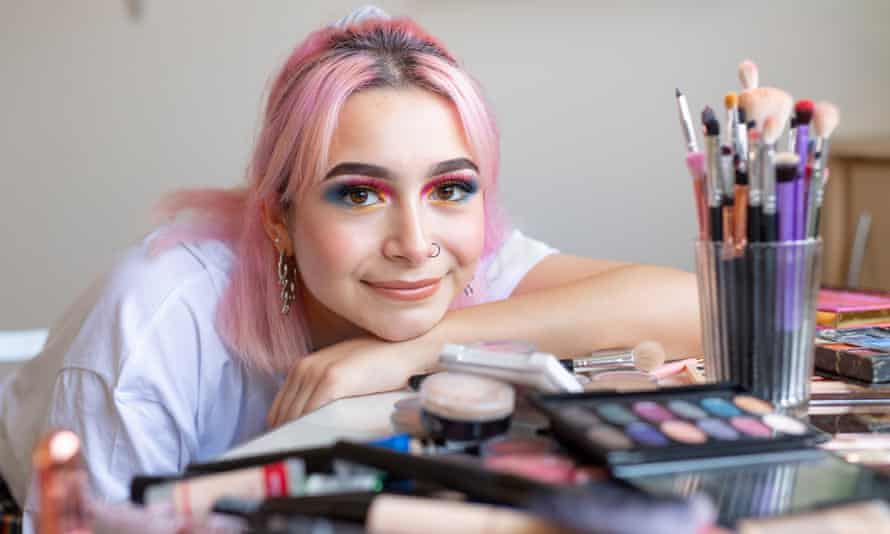
'It's literally art!" exclaims sixteen-twelvemonth-former Milly Provenzano, sitting cross-legged on her single bed. Her eyeshadow is like the plumage of a tropical bird: blueish, pink and yellowish, to lucifer the rainbow lettering on her Pride T-shirt. On the wall above her, Provenzano has taped up photographs of her favourite Instagram makeup stars: drag artist Hungry, famed for transforming Björk into a vagina-flower hybrid for the cover of her Utopia album, and Antoinette Mahr, whose trademark multicoloured style was clearly the inspiration for Provenzano'due south wait today. I take asked the teenager from Kettering, Northamptonshire, to justify the many hours she spends solitary in her room, perfecting fabulously complicated makeup looks. "That's like saying to someone who does A-level art and is painting all the time, 'Oh you shouldn't be doing that, yous should be doing something more than academic.' It'south just art, merely it'southward on your face."
Pulling out her phone, Provenzano shows me a list of makeup looks she would like to primary. Her inspirations are diverse and obscure. "I'd really like to practice an Error 404-inspired expect," she muses. "You know when something glitches online? Information technology'south mainly blackness and white, only also green and cherry." I scan the listing – what does the "eyebrow slits … just everywhere" entry hateful? "I've already washed that i!" she says. "I'd just given myself an eyebrow slit, and I woke upwards in the middle of the night and thought, why not do it everywhere on my face? So I got a tiny brush and concealer, and drew lines through my makeup."
Provenzano shows me a photo. Her optics are orangish. Her cheeks are a garish pink. At that place are thin lines downward her confront, as if her makeup has been stencilled around them. It is enormously impressive. After she finished the look, Provenzano uploaded a movie to Instagram, so done the makeup off. "Sometimes I go along it on if I really similar it," she shrugs. "Then a few hours later, I'll take it off."
Once, immature people used makeup equally visual lawmaking to proceeds admittance into different subcultures: blackness lipstick for goths, winged eyeliner for punks. At present, makeup is a subculture all of its own. In communities centred around Instagram and YouTube, young people gather virtually to look for inspiration, swap product tips and master tricky techniques. They often come to makeup through superstar vloggers such as NikkieTutorials (12.2m subscribers), Jeffree Star (15.6m subscribers) and James Charles, who boasts 15.9m subscribers, despite a series of scandals, one of which involved his former mentor releasing a 45-minute video claiming he had pressured heterosexual men to exit with him (claims he denied in another video), temporarily losing him millions of followers.
Beauty is big business. The market place research business firm Mintel valued the UK beauty and personal care market at £10.2bn in 2018. Spending is up: thirty% of women aged 16-24 say they vanquish out more than they did 12 months ago. Brands that work with pop influencers to corner the teen market will feel phenomenal growth – before this year, thousands of teenagers mobbed an appearance by Charles at the Birmingham store of the cosmetics brand Morphe. (The city was gridlocked for hours.) Popular makeup conventions such as Beautycon or Imats (the International Makeup Artist Trade Bear witness) describe thousands, while young people compete on shows such as the BBC's Glow Up to be recognised as U.k.'s freshest makeup talent.
In this customs, your face is a canvas for incongruous, dreamlike, article of clothing art. All y'all need is some pocket coin and a smartphone. But what is fascinating nearly this new subculture is that it is non taking place in crowded moshpits or twilit parks, but quietly in bedrooms. "I don't go out much," says Provenzano. "My friends come up here or nosotros go to their houses … but we don't really get places."
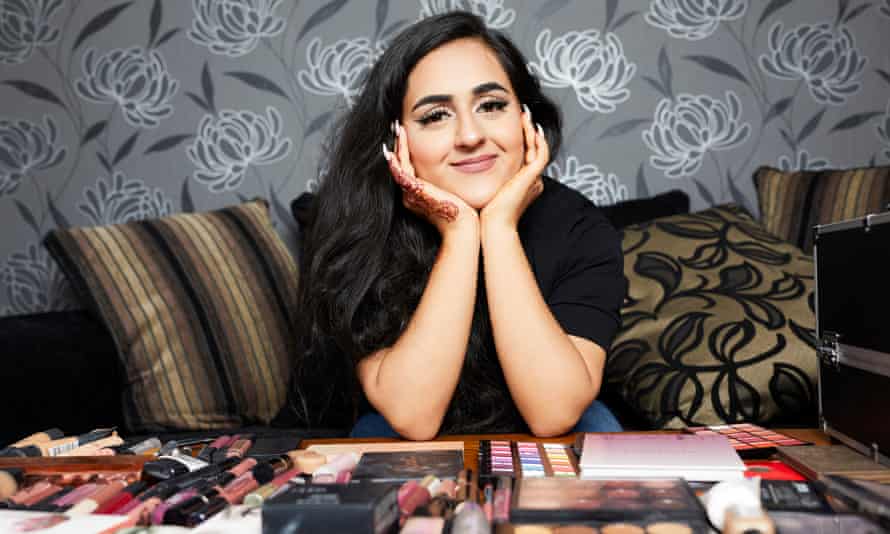
Aiman Sheeraz, a 17-year-old from Manchester, says: "My favourite skill is blending. This is what YouTube has taught me – to blend my life abroad." Sheeraz got into beauty because of her mum, who loved makeup. "We'd sentry Asian bridal makeup tutorials and effort to recreate them together. Looking dorsum at the pictures, they were so horrific!"
After her mum died two and a half years ago, Sheeraz started doing makeovers on her family and friends, posting the results online. "I thought, why not go my talent out there?" At first, Sheeraz did the makeup thing to award her mum. But soon it took on a life of its own. "It was never what I wanted to do total-time," says Sheeraz, who is studying for an apprenticeship in accountancy. "Information technology'southward more something to do on her behalf and brand her happy. But now I really enjoy information technology myself. I guess I'm doing it for her in a way."
As with any subculture, there are different tribes. Fans tend to divide into two camps: the beginning are lovers of the haute-glam look popularised by the Kardashian-Jenners and makeup artists such as Mario Dedivanovic and Kevyn Aucoin. Sheeraz falls into this category, describing her style as "Asian glam": "a very glowy base, full coverage, brilliant lips and eyes, but likewise something that you can wear to weddings and events – it won't merely look prissy in pictures." Meanwhile, artistic makeup fans prefer art-driven, colourful looks. "With creative makeup in that location aren't many rules, you can exercise what you want," says Niamh Dunne, a 19-year-one-time supermarket worker from Corby, Northamptonshire. Dunne takes inspiration from films or Television receiver shows such as Stranger Things. Afterwards the Lion King reboot came out, she freehand-painted the amber and ochre colours of an African sunset on her chest. It took three hours.
Critics may say that immature people shouldn't be messing around with blusher – they should be focusing on their careers. But this is wildly missing the marker: beauty is a very lucrative career choice. Just ask Kylie Jenner, who congenital a billion-dollar fortune off the back of her cosmetics visitor (although sales are rumoured to exist down). Of the fourscore women on Forbes's then-called "cocky-made women" rich listing this year, 10 are from the makeup and skincare industries.
Sheeraz wants to get similar her idol, the beauty mogul Huda Kattan. "Being a woman of colour and getting to where she is from being an average person is really inspirational to me."
I wonder if any of the teens think information technology may be damaging to be and then focused on their appearance. They all bat those concerns abroad. "Near of the time I'm actually barefaced," Sheeraz says. "When I go to piece of work, I don't wear it, because I'd rather spend the time sleeping." Dunne agrees: "With teenage girls, in that location is so much pressure on the manner yous look – getting surgery and lip fillers and all of that stuff," she says. "I don't think information technology should be like that. I don't wear it considering I recall I need it. I habiliment information technology because I enjoy doing it."
It is non just girls who are perfecting makeup techniques you've never heard of, such as halo brows or lollipop lips. Brands such as Milk Makeup and Fluide have created genderless cosmetics ranges, while legacy players including Chanel and Givenchy take launched male person lines. They are targeting consumers similar 17-year-sometime Matt Tierney. "I remember sneakily telling my mum I had a Halloween party to go to when I was 14, so we could go to Superdrug and buy some makeup. She asked, 'Are you sure this is for Halloween?'" He laughs. Through YouTube, Tierney built up the confidence to experiment with makeup. "If I didn't run across people doing information technology online, I'd never take gotten into it. I live in a piddling village in Northamptonshire. I've never seen anyone walking around with a rainbow center or in drag. You don't see that here."
Of class, marketing makeup to men doubles the amount of production brands can sell. And there is no uncertainty that consumerism is at the centre of this subculture – to an alarming extent. Provenzano takes me to her local Superdrug. "If I'thou in boondocks, I'll come up in to take a expect," she says, fingering a yellow Revolution eyeshadow lovingly. (Provenzano favours affordable brands – although she has a few high-stop eyeshadow palettes by the US make Lime Offense – that aren't tested on animals.) Makeup influencers such every bit Jaclyn Loma have landed themselves in trouble with their immature fanbases over the quality of their products – in one case, her lipstick was said to incorporate metal shards. Tierney bought the James Charles 10 Morphe palette later on seeing it hyped online. "I didn't think information technology was that dandy, to be honest. Maybe everyone saying it was amazing was on his payroll."
Regulators have started to footstep in. In the US, the Federal Trade Commission wrote to loftier-profile influencers to warn them against "stealth shilling", where they fail to disclose they are being paid by brands. Earlier this year, the Britain's Competition and Markets Authority secured formal commitments from celebrities to be more transparent about paid-for endorsements.
Even so, young people may not be able to recognise when their favourite online makeup artists are pushing products considering they are paid to advertise them. "What nosotros come across in the research is that they don't really recognise the advertising in vlogs or on Instagram equally advertising, every bit much every bit they do on TV," warns Steffi de Jans of Ghent Academy. She characterises most beauty vlogs as finer advert: the vloggers are either being paid past the brand direct, or receiving free products. And this isn't just a 30-second cereal advert in a commercial intermission. "It's hours and hours in a row of advertising letters, and they're really engaging with information technology."
Subcultures take always been consumer-side by side: you lot purchase records, safety pins, miniskirts. Merely the deed of consumerism isn't peripheral to this emerging dazzler subculture – it'southward integral to it. This is consumerism equally subculture. Sheeraz estimates she has spent about £1,000 on products from brands including Anastasia Beverly Hills and Huda Dazzler, whose palettes retail for £forty to £60. Can a community that is and so predicated on consumer consumption truly be considered a subculture?
Probably non, says Dr Rehan Hyder of the University of the West of England, explaining that it is better to remember of these teenagers according to the concept of creative fandom, every bit coined by academic Henry Jenkins. "Fans aren't just consumers, merely producers. They're not participating passively, merely creating a community in which you share expertise, skills and collective intelligence." In the dazzler earth, they use makeup to establish themselves as persons of influence and skill – like Tierney, who aims to achieve 100k followers. "That would be a massive milestone," he says.
Every bit teenage pursuits go, however, information technology is hard to think of a more make clean-living way for immature people to be spending their time – a bottle of shoplifted vodka being passed around a park this is not. "I'm not actually a going-out person," says Dunne. "Yous merely get hungover and can't be productive the adjacent 24-hour interval." Tierney thinks that makeup gives young people something to do. "It'south quite wholesome," he laughs. "People who have no lives, sitting in their room with a ring low-cal on, blending makeup on their eyes!" (He recently got one of these lights himself.)
Ring lights, contour kits, an arsenal of brushes to make Picasso blush: for teenagers today, makeup isn't a superficial hobby, but a way of expressing their inventiveness, hopes and dreams. Dorsum in her bedroom, Provenzano does my makeup while telling me most her ambitions for the future – she aspires to be a makeup artist for fashion shows. "Going to London," she says dreamily, eyeshadow brush in hand. "The fashion weeks – Milan, London, Paris. Plainly I can't stay in Kettering and practice runways, considering it's and then small." And as she applies my eyeshadow with precision of a surgeon performing keyhole surgery, I close my eyes and remember: "Y'all'll get there."
Source: https://www.theguardian.com/fashion/2019/aug/27/extreme-makeup-girls-boys-generation-z-new-subculture
Posted by: jonesorid1941.blogspot.com
0 Response to "Where Does Modern Makeup Come From"
Post a Comment